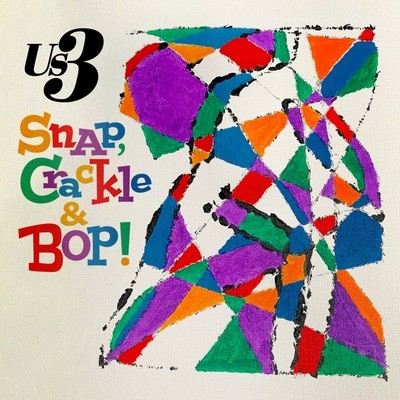
Vinyl - Us3 - Snap, Crackle & Bop!

Tracklist
Information
- Artist : Us3
- Format : 1 x 12"(140g)
- Sleeve : Color
- Genres :
- Estimated shipping date : December 2026
Legendary jazz and hip-hop fusionists Us3 serve up a refreshingly tasty treat with their much-anticipated 11th album, Snap, Crackle & Bop!. True to the genre-bending spirit that has defined the group for decades, the new album finds Us3 mastermind and producer Geoff Wilkinson once again bringing jazz, hip-hop, and an eclectic array of global influences together—while continuing to evolve the sound that made Us3 an international phenomenon.
After an extended absence, Wilkinson found himself on a journey through burnout, personal reinvention, and creative rediscovery—ultimately leading to a longing to get back to the good times. That journey brought him to MC Akil Dasan, who became the album's sole vocalist—a first for Us3.
“When I decided to make another Us3 album after such a long time, I knew the first guy I was going to reach out to was Akil,” says Wilkinson. “When he came over to record in London, I intended to feature two vocalists on the album, but we got such a lot of great tracks recorded with Akil that I decided I had everything I needed from just him. The variation in his work, his ability to ride on different rhythms, and his open-minded attitude were all major positives for me. He's a great guy and I love working with him.”
Joining Akil and Wilkinson is a trio of Us3 regulars. The result is an album that feels both familiar and fresh—a musical road trip that moves effortlessly through jazz, hip-hop, Afrobeats, Amapiano, Latin, Caribbean, and other global influences. The core lineup includes:
- Geoff Wilkinson: Production and mixing
- MC Akil Dasan: Vocals
- Ed Jones: Sax and flute
- Bryan Corbett: Trumpet and valve trombone
- Mike Gorman: Keyboards
Having released three prior singles—“Cool Cat”, “I Like To Party”, and “Have A Great Day”—fans can expect an irresistible mix seasoned with the unmistakable Us3 groove.
- “Have A Great Day”: A percussive Latin groove provides the backdrop for one of the album's most optimistic moments, with Akil championing positive thinking and encouraging listeners to celebrate individuality.
- “Catch A Vibe”: Captures Wilkinson's anything-goes approach to production. Beginning with a pulsing jazz foundation, the track moves through funky hip-hop, dark and moody trap, rolling Amapiano, and pounding Reggaeton rhythms before circling back to jazz.
- “One Step Ahead” & “You Got Me Open”: Caribbean flavors and steel drums meet trap-inspired beats, synths, and piano—creating a distinctly modern twist on the Us3 sound.
“I always like to try something new on every Us3 album,” says Wilkinson. “Often that is in the combination of seemingly unrelated things, but making them work together seamlessly.”
Throughout the 1990s, Us3 became a global fixture with their pioneering fusion of jazz and hip-hop. Their music traveled from underground clubs in London to the streets of Tokyo, the U.S., New Zealand, and far beyond, becoming part of the soundtrack of everyday life. Decades later, that cross-cultural dialogue remains at the heart of Us3. The difference is that Wilkinson is no longer simply looking back at what Us3 was. He's looking ahead at what it can still become.
“When I was a kid, my mum always used to say, ‘Life is a journey, not a destination,’” says Wilkinson. “And this is another big road trip!”
The album's twelve tracks ultimately deliver what the title promises: a playful, groove-heavy collection designed to make you Snap, Crackle & Bop!
Jazz hip-hop pioneer Us3’s fresh alchemy of hard-bop and hip-hop catapulted jazz into the mainstream in the early 1990s, earning the legendary label, Blue Note Records, its first Stateside platinum certification. It's ever-evolving artistic continuum would continue over 9 albums and 20 years, until the post-modern visionary behind it all, Geoff Wilkinson, pulled the plug in 2014 due to illness.
Healthy and bursting with creativity, the London-based producer has now relaunched Us3. Its first album in a decade is Soundtrack, a darkly cinematic instrumental 12-track collection that majestically ushers in a new era for the jazz hip-hop voyager.
“I felt like Us3 was snatched away from me—that there was unfinished business,” says Wilkinson. “There was a day I was in my studio working with trap beats, and I started thinking about Gil Evans horn arrangements from the 1950s and 1960s that I loved. It occurred to me that this amalgamation would be what Us3 would sound like if it started now.”
Us3 is a restlessly creative artistic adventure always pushing the conversation between jazz and hip-hop. It emerged as one of the vanguard acts of the British “acid jazz” scene with its 1991 12-inch single, “The Band Played The Boogie.”
That jam featured a sample of Blue Note Recording artist Grant Green’s ultra-funky “Sookie Sookie.” “The Band Played The Boogie” earned underground and mainstream attention, catching the ears of Blue Note Records who threatened to sue Us3. Instead, Wilkinson convinced the suits to sign him and production partner Mel Simpson, giving them access to sample more music from the Blue Note back catalog.
That proved to be a smart decision. Us3’s 1993 single on Blue Note, “Cantaloop (Flip Fantasia),” which sampled Herbie Hancock’s 1964 track, “Cantaloupe Island,” and featured UK trumpeter Gerard Presencer, became a Top 10 hit around the World. Eventually it was included on Us3’s Blue Note Debut, Hand On The Torch, which went on to sell over 2.5 million copies.
Us3 would go on to make records independently, with jazz and hip-hop fueled sojourns into world music, neo-soul, and beyond. Its fifth album, the critically-acclaimed, Schizophonic, reimagined Us3’s mission through hosting vibrant conversations in hip-hop and jazz with live jazz musicians, a turntablist, and two MCs. In 2009, Us3 dropped its seventh album, stop. think. run, a favorite of hip-hop heads due to its inventive beats and firebrand rhymes.
Throughout, Us3 has been Wilkinson’s brainchild. He is a self-taught producer and former DJ at London’s legendary Jazz Cafe with a freewheeling artistic perspective. “I can remember talking with our original A&R man about Bowie, and how exciting it was that every album he made in the 1970s was different,” Wilkinson recalls. “That’s what I wanted to do with Us3—we even joked about making a salsa album!”
Wilkinson would indulge some of his shapeshifting antics with Us3, but many of his bold explorations happened off the Us3 clock. After the project went on hiatus, Wilkinson remained active as a musician composing sound library music.
Freed from the pressures of justifying his music to record labels and music critics, Wilkinson reveled in exploring an eclectic array of genres in his own studio. It was there he stumbled upon the Soundtrack aesthetic. “In my head, I was making a 21st century Sketches Of Spain/Miles Ahead,” Wilkinson shares, “those albums certainly served as inspiration”.
Soundtrack exudes a moody luxuriousness with its 18-piece horn section propelled by trap beats whose intricate rhythmic patterns recall the polyrhythmic approach of a jazz drummer like Elvin Jones. The track, “What Have We Done,” epitomizes the album’s stylistic union with glitchy trap beats tucked beneath a winsome orchestral top-line. On “Resist The Rat Race,” mesmerizing low-register piano motifs and menacing horn lines capture classic “cop chase” tension, recalling soundtrack masterworks by composers Don Ellis and Henry Mancini. The cinematic sense of mystery of “Skin On Skin” recalls 1960s Quincy Jones soundtracks. The lone track with a vocal, the sensual “Save Me,” evokes Us3’s classic jazz hip-hop sensibility.
Us3’s legacy is fomenting a cross-cultural hip-hop and jazz dialogue that remains as vital today as ever. Pondering Us3’s ascent, Wilkinson marvels: “This thing started in a basement studio with two guys and a sampler, and I never anticipated the success it would have. I was just doing what felt relevant then and I’m still doing that now.”